
How much does a new roof cost in Minneapolis? For most Twin Cities homes, a full asphalt shingle roof replacement runs $9,000 to $22,000 in 2026. The average for a typical 2,000–2,500 sq. ft. home with architectural shingles lands around $12,000–$18,000 installed.
Those numbers are real. They’re not a teaser range designed to get you on the phone. And they’re specific to the Minneapolis market — not national averages that consistently underestimate what Minnesota contractors will actually quote you.
What puts a roof at the low end of that range versus the high end? That’s what this guide is for. We’ve been roofing homes in the Twin Cities for 30 years. Every factor that drives roof cost — material, size, pitch, deck condition, insurance — we’ve seen it play out thousands of times. Here’s the full picture.
New Roof Cost in Minneapolis by Material (2026)
Material is the single biggest variable in what a new roof costs. Here’s what to expect for each option in the Twin Cities market.
Asphalt Shingles
Asphalt shingles are what most Minneapolis homeowners choose — and for good reason. They handle Minnesota winters well, come in dozens of styles and colors, and offer the best upfront value of any roofing material.
There are two main tiers:
Standard 3-tab shingles are the basic option. Flat, uniform appearance. 20–25 year rated life. Cost: $7,000–$12,000 for a typical Twin Cities home. Less common today because architectural shingles aren’t significantly more expensive and perform noticeably better.
Architectural (dimensional) shingles are the standard choice for most replacements. Thicker, textured, better wind resistance, 30-year-rated life. Class 4 impact-resistant shingles — rated to resist hail up to 2 inches — are increasingly popular in Minnesota after back-to-back heavy hail seasons. They often qualify for insurance discounts that offset the higher material cost.
Cost range for asphalt shingles (installed, Twin Cities 2026): $9,000–$22,000
Metal Roofing
Metal roofs last significantly longer than asphalt — 40 to 70 years depending on the type — and handle Minnesota weather better in several ways: snow sheds off faster, they won’t crack from freeze-thaw cycles, and hail resistance is excellent.
The tradeoff is cost. Standing seam metal — the premium option — runs $26,000–$48,000 installed for a typical Twin Cities home. Metal panel systems and metal shingles are available at lower price points.
For a homeowner planning to stay in the house 20+ years, the long-term math on metal often works out favorably. For a 5–10 year homeowner, asphalt wins on ROI.
Cost range for metal roofing (installed): $20,000–$48,000+
Cedar Shake
Cedar shake roofs have been on Minnesota homes for generations. They look distinctive, insulate well, and age in a way most homeowners find appealing. They also require more maintenance than asphalt or metal — periodic treatment, moss prevention, and faster replacement of damaged sections to prevent moisture infiltration.
Cost range for cedar shake (installed): $28,000–$55,000
Synthetic Roofing Materials
Polymer and composite shingles engineered to look like cedar shake, slate, or tile are gaining ground in the Twin Cities. They match the aesthetics of natural materials with better durability and less maintenance. Lifespans of 40–50 years are common. Cost sits between standard asphalt and cedar shake.
Cost range for synthetic shingles (installed): $14,000–$28,000
Quick Cost Comparison
| Material | Typical Cost (Installed, MN 2026) | Life Expectancy |
|---|---|---|
| 3-tab asphalt shingles | $7,000–$12,000 | 20–25 years |
| Architectural asphalt shingles | $9,000–$22,000 | 30 years |
| Class 4 impact-resistant shingles | $11,000–$24,000 | 30 years |
| Synthetic/composite shingles | $14,000–$28,000 | 40–50 years |
| Metal roofing | $20,000–$48,000+ | 40–70 years |
| Cedar shake | $28,000–$55,000 | 25–30 years (maintained) |
New Roof Cost by Home Size
The larger the roof, the more materials and labor are required. Roofing is typically priced per “square” — a 10×10 foot section, 100 square feet. Here’s what roof replacement cost by home size looks like for architectural asphalt shingles in Minneapolis:
| Home Size (Footprint) | Approximate Roof Area | Estimated Cost |
|---|---|---|
| Small home/garage (under 1,500 sq ft) | 15–20 squares | $7,000–$12,000 |
| Average home (1,500–2,500 sq ft) | 20–28 squares | $12,000–$19,000 |
| Larger home (2,500–3,500 sq ft) | 28–38 squares | $18,000–$27,000 |
| Large/complex home (3,500+ sq ft) | 38+ squares | $25,000–$45,000+ |
These are asphalt shingle numbers. Material upgrades push costs higher across all size categories.
What Affects the Cost of a New Roof?
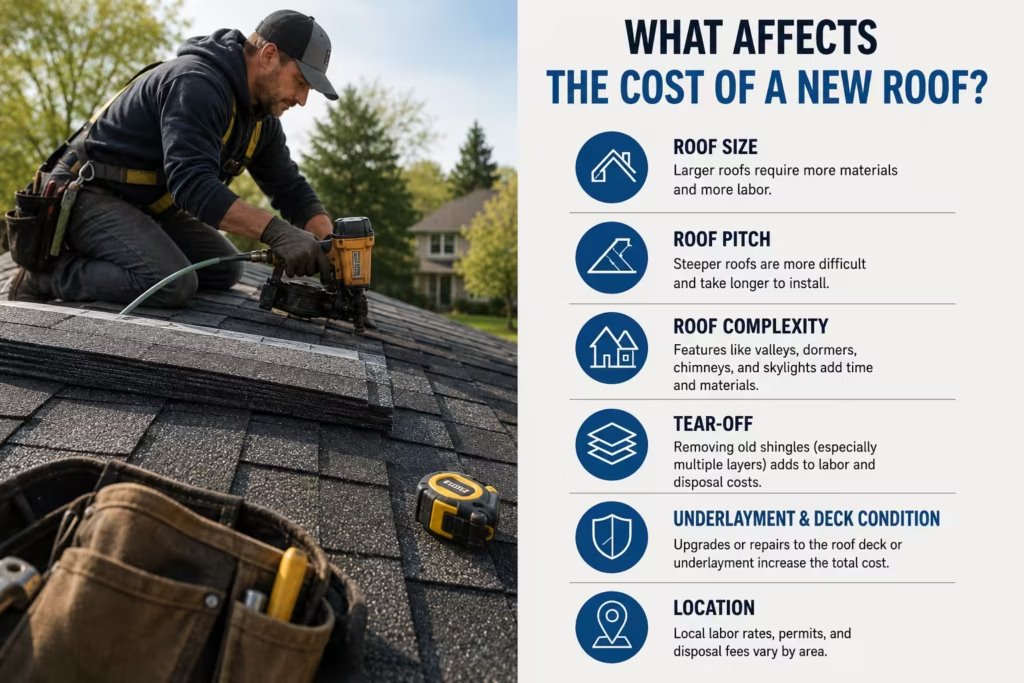
Home size and material choice account for most of the variation. These factors determine where within the range your project actually lands.
Roof Size
Bigger roof, bigger bill. More square footage means more materials and more labor — and after material choice, size is the single biggest driver of total cost. Roofing is priced per “square” — that’s a 10×10 section, or 100 square feet. A 30-square roof costs roughly 50% more than a 20-square roof, all else equal.
Roof Pitch
Pitch — how steep your roof is — directly affects labor cost. A low-slope or walkable roof is faster and safer to work on. A steep roof (above 8/12 pitch) requires specialized equipment and more time. Steep roofs typically add 20–40% to labor cost compared to a standard-pitch roof.
Roof Complexity
A simple gable roof with two slopes and no obstructions is the fastest to install. Every feature adds time and materials: valleys where roof sections meet, dormers, skylights, chimneys, multiple peaks. Complex rooflines can increase total cost by 25–50% over a simple equivalent footprint.
Tear-Off: One Layer or Two?
Minnesota code allows a maximum of two shingle layers on most residential roofs. If your home already has one layer, the new roof goes over a single tear-off. If there are two existing layers, both come off before the new roof goes down — that’s a code requirement, not a contractor preference.
Double tear-off adds $800–$1,500 in labor and disposal cost. If a contractor bids a two-layer roof without mentioning the double tear-off, they either missed it or are planning to install over it illegally. This is one of the things we verify during our free inspection.
Decking Condition
Once the tear-off is complete, we can see the bare deck for the first time. Rotted boards, delaminated plywood, or soft spots from old leaks need replacement before the new roof goes on. Most projects have minimal deck replacement. Homes with a history of leaks or ice dam damage sometimes need more. This is the variable no contractor can price accurately over the phone — it only becomes visible on the day of tear-off.
Location
Local labor rates, permit requirements, and disposal fees vary by area. Twin Cities contractors generally run higher than rural Minnesota — typically 8–12% lower in outstate markets. Urban Minneapolis jobs may also carry higher permit costs than suburban communities.
Ice-and-Water Barrier and Underlayment
Minnesota’s climate makes proper underlayment critical. Ice-and-water shield is required at eaves and vulnerable points — valleys, skylights, chimneys — by Minnesota code. Better-quality synthetic underlayment costs more but performs significantly better than felt paper, especially in the freeze-thaw conditions our winters produce. These components are typically included in a complete quote. If they’re not listed, ask.
How Insurance Can Change the New Roof Cost Equation
This is the factor that changes the math most dramatically — and the one most Twin Cities homeowners don’t fully understand.
Minnesota has some of the highest hail frequency in the country. A hailstorm that most homeowners shrug off — quarter-sized hail, brief duration — can cause damage that qualifies for a full insurance-covered replacement. The homeowner pays their deductible. Insurance pays the rest.
The same applies to significant wind damage.
Here’s what this means practically: many Minneapolis homeowners who believe they’re facing a $15,000 out-of-pocket roof replacement are actually looking at a deductible of $2,000–$4,000 once a qualified inspection documents the storm damage correctly.
We inspect roofs for storm damage every week. When we find hail hits, granule loss, or wind damage consistent with a qualifying storm event, we document it and walk homeowners through what a claim would look like. We don’t push unnecessary claims — but we also don’t let homeowners pay out of pocket for something their insurance should be covering.
If you’ve had any hailstorm or significant wind event in the last 1–2 years and haven’t had your roof inspected, that’s worth doing before you commit to paying for a full replacement out of pocket.
New Roof Cost vs. Ongoing Repair Costs: The Real Comparison
We get asked regularly whether it makes more sense to keep repairing an aging roof or just replace it. Here’s how we think through it.
A roof repair — patching a section, replacing flashing, fixing a leak — typically runs $300–$2,800 depending on scope. One repair a year on an aging roof is manageable. Two or three repairs in the same season usually signals the roof is entering failure mode — one problem keeps pointing to another.
The 50% rule applies here: when cumulative repair costs approach 50% of replacement cost, replacement is almost always the better investment. A $3,000 repair on a 20-year-old roof that still needs replacement in two years is money that didn’t extend the roof’s useful life — it just delayed the same conversation.
We give homeowners our honest read during every inspection. If a roof repair is genuinely the right call, we say so and quote it. If replacement makes more financial sense, we explain why with numbers — not just a recommendation.
What’s Included in a Complete Roof Replacement Quote?
This is worth knowing because not all quotes include the same things — and the gap between a complete quote and a lowball can be $2,000 to $5,000 of work that shows up as a surprise later.
A complete roof replacement quote should include:
- Full tear-off of existing shingles (one or two layers)
- Inspection and replacement of damaged decking
- Ice-and-water shield at all required locations
- Synthetic underlayment across the full deck
- New drip edge flashing
- Ridge cap shingles
- Pipe boot and flashing replacement
- Debris removal and disposal
- Permit (where required)
- Workmanship warranty
If a quote is missing any of these and comes in significantly lower, the difference isn’t savings — it’s scope that you’ll pay for separately, or that will cause problems later.
How to Get a Fair Roof Replacement Quote in Minneapolis
Getting the right number starts before you call anyone.
Know your roof’s age and history. If you bought the house and don’t know when the roof was last replaced, check the permit records through your city or county. Sellers are often wrong about roof age — we verify it every time.
Get two or three written quotes. Not to find the lowest number, but to see whether the scope is consistent across contractors. When one quote is significantly lower, the difference is almost always in what it includes.
Ask what it doesn’t include. Specifically: Is double tear-off accounted for? Is deck replacement priced separately? What underlayment system is being used?
Check MN contractor license. The Minnesota Department of Labor and Industry license lookup takes two minutes. Our license is BC794536.
Don’t pay for a full replacement before checking insurance. If you’ve had hail or significant wind in the last two years, an inspection first.
For a starting estimate based on your home, our instant roof quote tool gives you a real range in minutes.
FAQs: How Much Does a New Roof Cost?
Most Twin Cities homes pay $9,000–$22,000 for a full asphalt shingle roof replacement. The average for a 2,000–2,500 sq. ft. home runs $12,000–$18,000 installed. Metal roofing runs $20,000–$48,000. Exact cost depends on home size, material, roof complexity, pitch, and deck condition.
Architectural asphalt shingles run $5.75–$8.25 per square foot installed in the Twin Cities. Metal roofing runs $12–$22 per square foot. These figures include tear-off, materials, labor, underlayment, and standard accessories.
If the damage is storm-related — hail, wind, ice — and documented correctly, homeowner’s insurance typically covers full replacement minus your deductible. Minnesota has high hail frequency, and many homeowners are sitting on a qualifying claim they haven’t filed. An inspection is the first step.
Most residential roof replacements in Minneapolis take one to two days, depending on home size, roof complexity, and weather. Permit processing, if required, happens in advance and doesn’t typically extend the installation timeline.
3-tab asphalt shingles are the lowest upfront cost — $7,000–$12,000 for a typical home. Most contractors, including us, recommend architectural shingles instead for a modest cost difference that delivers better performance and wind resistance meaningfully in Minnesota conditions.
Free Roof Inspection in Minneapolis and the Twin Cities
If you’re trying to figure out how much a new roof costs for your specific home — or whether a repair or insurance claim changes the equation — the right starting point is an inspection, not a phone estimate.
Gopher Roofing & Restoration has served Minneapolis and the surrounding Twin Cities for 30 years. We inspect roofs, document storm damage, explain what we find, and give you a complete, itemized quote that doesn’t change once we start work. We serve Minneapolis, St. Paul, Golden Valley, Maple Grove, Plymouth, Bloomington, Edina, Minnetonka, Eagan, Eden Prairie, Roseville, and throughout the metro.
Free inspections. No pressure. An honest number.
📞 Call (612) 331-7663 for your free inspection.